ELC Challenges Harmful Federal Priorities That Undermine Public Schools

ELC submitted public comments June 18, 2025, in response to the U.S. Department of Education’s proposed priorities and definitions for discretionary grant programs. The department aims to prioritize funding for “evidence-based literacy, expanding education choice, and returning education to the states.”


ELC’s comments focus on our concerns that the administration’s stated intent, made clear in their press release, would abandon proven school initiatives like social emotional learning; diversity, equity and inclusion practices; and efforts to recruit and retain diverse educators. Our comments also denounce the department’s harmful “education choice” agenda, which would divert taxpayer dollars away from traditional public schools to private and charter schools that serve fewer of our most vulnerable student groups and often fail to deliver better outcomes.


Finally, our comments underscore the critical role of the U.S. Department of Education in funding public schools, enforcing education laws, and protecting students from discrimination and civil rights violations.

2004: ELC Challenges Racial Inequities in Teacher Placement

Each month in 2025, we are highlighting an ELC milestone or success as we mark our 50th anniversary. See our timeline of ELC milestones here. 

Two decades ago, Education Law Center turned its attention to the issue of racial inequities in students’ access to qualified teachers in Philadelphia schools – initially by filing a federal civil rights complaint.

In a complaint to the U.S. Department of Education’s Office for Civil Rights, ELC lawyers alleged that in the School District of Philadelphia, schools serving larger percentages of students of color were more likely to have uncertified or inexperienced teachers and higher teacher turnover than schools serving larger percentages of white students.

“A knowledgeable and experienced teacher can make a huge difference in a child’s achievement,” Len Rieser, then ELC co-director, said at the time.

ELC cited studies to buttress its argument, which also applied to students experiencing poverty. At that time, Research for Action, for instance, found that it was “not uncommon” at middle schools with the highest percentages of students experiencing poverty for 20% of the staff to have less than a full year of teaching experience in the district.

The complaint noted that in district middle schools that served 90% or more students of color, 20% of teachers were not certified. But in middle schools where most students were white, only 1.4% of teachers were uncertified. Schools that had the highest proportions of students of color and students experiencing poverty also had higher levels of teacher turnover, ELC argued.

The complaint brought scrutiny to the way the district assigned teachers; at the time, qualified and experienced teachers were allowed to pick their own assignments.

“And schools serving large numbers of students of color got left behind in the process,” Rieser said. He told Education Week: “We have a two-tier [education] system along racial lines.”

The Office for Civil Rights eventually dismissed the ELC complaint, citing other pending litigation against the district.

Even so, concerns about the racial inequities in students’ access to qualified teachers led to the formation of a coalition of more than two dozen advocacy and student groups, including ELC, in what was called the Teacher Equity Campaign. The immediate aim was to influence ongoing teacher contract negotiations. Issues included the district’s practices in school assignment, hiring, and placement of teachers.

The resulting 2004 contract agreement, reached between the Philadelphia Federation of Teachers and the School Reform Commission, included new policies for school-based selection of teachers instead of teachers self-selecting, limits on seniority-based transfer rights, and incentives for teachers who sought employment in selected “incentive schools” and in selected subjects.

ELC and the Teacher Equity Campaign continued to advocate for further reforms in subsequent contract negotiations.

News outlets and education researchers in recent years have documented continuing inequities and high rates of teacher turnover in city schools predominantly serving students of color and students from low-income neighborhoods. 

In response, the School District of Philadelphia has employed additional reform strategies to strengthen teacher recruitment and retention, including financial incentives. In the 2024 teachers’ contract, for instance, the district agreed to pay $1,200 retention bonuses, re-engagement bonuses to all teachers, and $2,500 bonuses to teachers in schools with high numbers of vacancies.

ELC continues to advocate for racial equity in teacher quality, and this was an important issue in our school funding case.

ELC Comments on PHRC Proposed Guidance for Evaluating Claims of Bullying & Harassment under the PHRA

On August 29, 2024 ELC submitted comments to the Pennsylvania Human Relations Commission (PHRC) regarding their proposed Guidance on Evaluating Claims of Bullying and Harassment Under the Pennsylvania Human Relations Act (PHRA). ELC strongly supports the proposed guidance as an important vehicle for clarifying the rights and protections of students. Additionally, ELC recommends that the proposed guidance be revised to delineate and further clarify the definition and nature of harassment, the scope of schools’ liability, to ensure investigations are prompt, independent and comprehensive, and ensure schools proactively implement correction action. We believe that these changes are important to prevent and address the lasting negative impact that harassment and bullying can have on a child’s education.

Civil Rights Complaint Challenges Discriminatory Policies in Pennridge School District

NAACP, PairUP Society, and Bucks County Families File Federal Civil Rights Complaint Challenging Discriminatory School Policies

November 15, 2023 – Several Bucks County families have joined with civil rights and advocacy groups to file a federal civil rights complaint on behalf of parents and students in the Pennridge School District, challenging the District’s discriminatory policies and its “hostile environment rife with race- and sex-based harassment.”

The complaint, filed today to the Office of Civil Rights (OCR) in the U.S. Department of Education and the Department of Justice Civil Rights Division, alleges racially discriminatory and anti-LGBTQ+ policies and practices in Pennridge schools, including a failure to address bullying of students of color and LGBTQ+ students, curriculum changes designed to remove discussion of racism and oppression from classrooms, banning of books that represent diverse experiences, and discriminatory bathroom and sports policies. The complaint asks the District to directly address race- and sex-based harassment to ensure that it does not recur and to adopt policies that affirmatively foster the inclusion of marginalized students.

The complaint was filed on behalf of the Bucks County NAACP, the PairUP Society, and affected families by the Education Law Center-PA and the Advocacy for Racial and Civil Justice Clinic of the University of Pennsylvania Carey Law School.

“For years, teachers, students of color, and LGBTQ+ students have reported race- and sex-based harassment, including students routinely using the N-word toward Black students and students threatening violence against LGBTQ+ students,” the complaint states. “But District officials have refused to remedy the systemic and pervasive forms of race- and sex-based harassment.”

“All students deserve safety and dignity at school,” said Karen Downer, president of the Bucks County NAACP, an organization represented in the complaint. “Unfortunately, Pennridge has created an environment that is hostile for some students because of their race, sex, or gender identity.” Title VI and Title IX of the Civil Rights Act prohibit discrimination based on these characteristics, and schools are legally required to take action when they are notified of a hostile environment that prevents some groups of students from fully participating in educational opportunities.

In an investigation that led to the filing of the complaint, advocates spoke to students who described persistent harassment that went unaddressed by administrators, in some cases pushing affected students to switch to online learning or to leave the District entirely. Because of privacy concerns, portions of the stories shared in the complaint are redacted, but they include students of color who faced racist comments at school, as well as LGBTQ+ students who experienced slurs, harassment, and threats of violence.

In response to her child’s experience hearing racial slurs and threats at school, Pennridge parent Adrienne King founded the PairUP Society, a nonprofit that supports underrepresented students facing bullying in schools. “No child should have to choose between their safety and their education,” she said. “Pennridge School District has a duty to protect students of all identities so that they are not prevented from learning simply because of who they are.”

Advocates say that Pennridge has failed to address race- and sex-based harassment, instead exacerbating the hostile environment by disbanding Diversity Equity and Inclusion initiatives, prohibiting teachers from displaying pride flags, limiting discussion of racism in the social studies curriculum, and removing diverse reading materials from the library.

“Our thanks to the brave students and advocates who have faced callous, hostile, and harmful school environments for years but did not give up in the fight to make their school communities better,” said attorney Ashli Giles-Perkins of the Education Law Center. “Pennridge School District has to address the racial and LGBTQ+ discrimination that continues to plague its school community. The situation calls for strong interventions from the federal government.”

“We hope that this lawsuit will be a step towards ensuring future students of all identities can learn and thrive at Pennridge schools,” said Annamarie Hufford-Bucklin, a Penn Carey Law student in the Advocacy for Racial and Civil Justice Clinic who worked on the complaint.

“The District has an obligation to comply with the Civil Rights Act and to ensure an environment that is inclusive and welcoming to all,” said Keith Matier, a law student in the Advocacy for Racial and Civil Justice Clinic who also worked on the complaint.
Class Action Suit Against Glen Mills Schools and Pa. Officials Cites Abuse of Children, Deprivation of Education

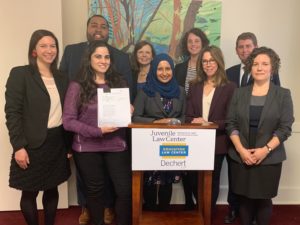
Lawyers from the Education Law Center, Juvenile Law Center, and Dechert LLP filed a class action lawsuit April 11 in Philadelphia on behalf of hundreds of youth who were held at Glen Mills Schools, a residential facility located in Delaware County. This site, the oldest reform school in the country, housed as many as 1,000 boys from all over the country – and the world – at one time. After an emergency removal order of all remaining children at the facility as well as the revocation of its licenses by the Pennsylvania Department of Human Services, it is currently empty; these actions followed groundbreaking investigative reporting by the Philadelphia Inquirer’s Lisa Gartner.

The legal team from Education Law Center, Juvenile Law Center, and Dechert LLP

The suit maintains that these youth housed at Glen Mills suffered at the hands of Glen Mills leadership and staff. Instead of receiving treatment and services, as required by the Pennsylvania Juvenile Act, plaintiffs claim that they were subjected to extreme and sustained physical and psychological abuse and deprived of an education. The abuse had a particularly dire impact on youth of color – the vast majority of Glen Mills youth were African American – as well as students with special education needs and disabilities, whose educational and other rights were ignored.

The suit asserts that officials at the Pennsylvania Department of Education and the Chester County Intermediate Unit allowed Glen Mills’ education program to operate in the shadows without any oversight or monitoring to ensure the educational rights of students. The suit also maintains that the persistent and barbaric abuse went unchecked due to the Pennsylvania Department of Human Services “callous disregard for the safety and well-being of the children in its care.” PA-DHS is the body responsible for the licensing, oversight and regulation of child residential facilities in the Commonwealth.

Plaintiffs seek damages as well as other equitable relief for violations of their rights under the Eighth and Fourteenth Amendments to the US Constitution, the Individuals with Disabilities Education Act, Section 504 of the Rehabilitation Act, the Americans with Disabilities Act,  and state common law claims.

Read our press release here.

Read our complaint here.

Read press coverage of the lawsuit here, here, and here.